
Maths
How we teach Maths:
At Ellen Wilkinson Primary School, we follow the Collins Busy Ants Mathematics programme to provide a structured, progressive, and engaging mathematics curriculum. Mathematical concepts are taught and revisited throughout the year to strengthen understanding, secure retention, and support pupils in achieving mastery.
We are committed to ensuring that every child is challenged and supported to reach their full potential. The programme offers a coherent and carefully sequenced curriculum that promotes progression in mathematical knowledge, skills, and understanding across all year groups.
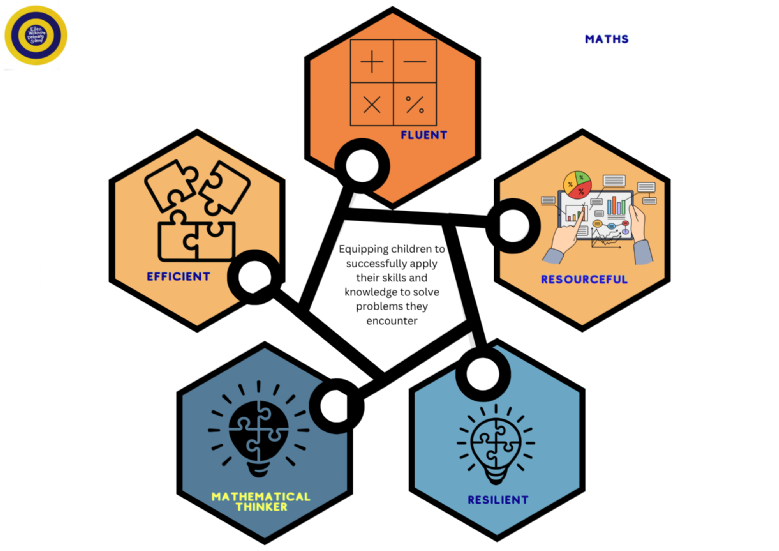
Pupils are given regular opportunities to apply their learning in meaningful, real-life contexts, developing fluency, reasoning, and problem-solving skills. In addition, we place a strong emphasis on the development of arithmetic proficiency through explicit teaching, alongside participation in the Mastering Number programme across both Key Stage 1 and Key Stage 2. This approach helps to build strong number sense and confidence, providing a secure foundation for future mathematical learning.
How we ensure access for all:
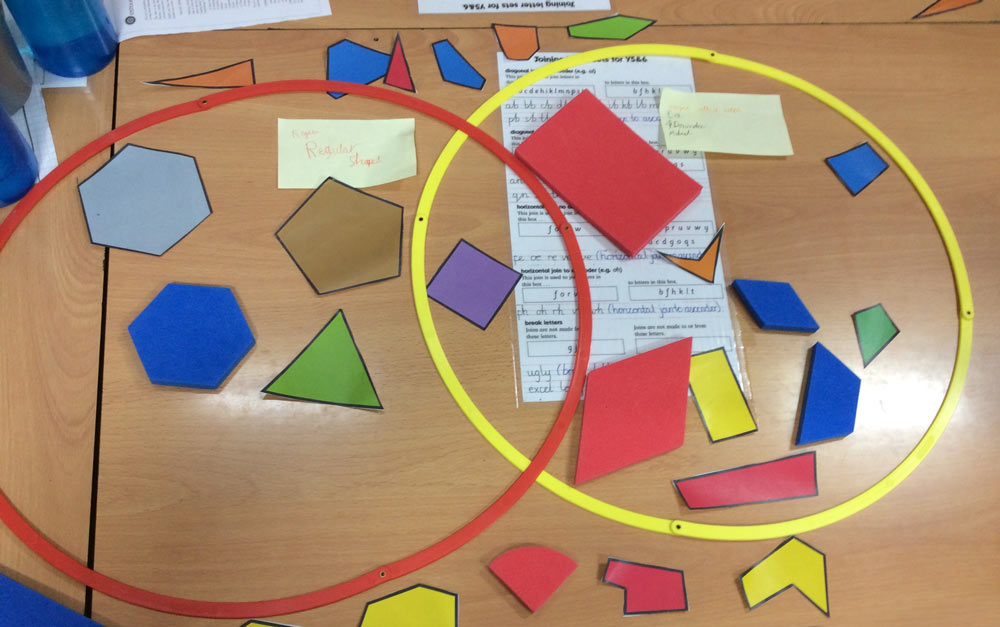
At Ellen Wilkinson Primary School, we are committed to ensuring that all pupils can access and succeed in mathematics. Through high-quality teaching, carefully selected resources, visual aids, targeted interventions, and adaptive classroom practice, we support children to engage confidently with their learning and make strong progress.
We provide a range of support materials, including Collins support tasks, as well as stretch and challenge activities to meet the needs of all learners. This ensures that pupils receive the appropriate level of support or challenge to help them achieve their full potential. The Collins Busy Ants programme is designed with a clear progression in difficulty, enabling children to access learning at an appropriate starting point while providing opportunities to deepen and extend their mathematical understanding.
How we develop cultural capital:
At Ellen Wilkinson Primary School, we recognise the importance of cultural capital in providing children with a rich and broad curriculum that prepares them for life beyond the classroom. We are committed to offering a wide range of learning opportunities and experiences that enable our pupils to achieve academic success while developing the knowledge, skills, and confidence needed to engage positively with the wider world.
To broaden children’s horizons and deepen their understanding of the relevance of mathematics, our curriculum highlights the connections between mathematics and other areas of learning. Through meaningful cross-curricular links with subjects such as Design and Technology, Science, and Computing, pupils are encouraged to apply their mathematical knowledge in a variety of contexts. This approach enhances mathematical thinking, promotes problem-solving skills, and helps children to appreciate the vital role mathematics plays in everyday life and future careers.
How we know your child is succeeding:
Assessment is an integral part of every Mathematics lesson at Ellen Wilkinson Primary School. Teachers use a range of Assessment for Learning (AfL) strategies to regularly check pupils’ understanding, identify misconceptions, and respond promptly to individual learning needs. Any misconceptions are addressed through high-quality in-class support, targeted questioning, and, where appropriate, additional intervention sessions.
At the end of each lesson, teachers evaluate pupils’ progress against the intended learning objective. This ongoing assessment informs future planning, ensuring that teaching is responsive and tailored to the needs of the class.
Pupils are formally assessed four times throughout the academic year. These assessments enable teachers to monitor progress and determine whether children are on track to meet the age-related expectations for their year group. In addition to these formal assessments, a range of assessment activities and evidence from day-to-day learning are used to support teachers’ professional judgements, providing a comprehensive picture of each child’s attainment and progress in Mathematics.
How you can support your child:
Parents and carers play a vital role in helping children develop confidence and enjoyment in mathematics. We encourage families to promote a positive attitude towards maths and to look for opportunities to explore mathematical concepts in everyday life.
Simple activities such as shopping, cooking, travelling, and managing time provide valuable opportunities for children to apply and develop their mathematical skills in real-life contexts. We also recommend reading the curriculum overviews to gain an understanding of the topics your child will be learning throughout the year. Our progression and tracking documents can help you support your child if they need additional practice or are ready to extend their learning in preparation for the next year group.
Practical Ways to Support Maths at Home
- Regularly check and reinforce your child’s understanding of key mathematical concepts and number facts.
- Help your child learn and recall number bonds with confidence.
- Support the development of multiplication and division skills through regular practice.
- Encourage accuracy when measuring and recording, particularly when using equipment such as rulers and scales.
- Practise times tables frequently to build fluency and recall.
- Involve your child in everyday calculations, such as adding the cost of items while shopping.
- Encourage the use of written methods for addition and subtraction involving larger numbers.
- Help your child recognise, name, and describe 2D and 3D shapes.
- Explore fractions through practical activities, such as sharing food or measuring ingredients.
- Use negative numbers in real-life contexts, such as discussing temperatures.
- Encourage your child to tell the time regularly using both analogue and digital clocks.
- Discuss journeys and travel times, comparing different routes and durations.
- Support your child in understanding the relationships between fractions, decimals, and percentages.
- Introduce mathematical equipment, such as protractors, and explore how angles are measured.
- Use quizzes, games, and practice tests in a positive and enjoyable way to identify areas for development and celebrate progress.
- Continue to revisit and practise basic mathematical skills, as these provide the foundation for success in all areas of mathematics.
By engaging with mathematics regularly at home, children can develop greater confidence, fluency, and resilience, helping them to achieve their full potential.
Useful links:
| Website: | What it's about: |
|---|---|
 |
Use this to access all your other platforms |
|
|
Access activities set for you by your teacher or engage in adaptive practice to improve your Maths knowledge. You will need your Freckle login. |
|
|
TopMarks Education has lots of fun educational games for you to play. No login required. |
|
|
Log in with your TT Rockstars username and password to access lots of different times table challenges.
|
 |
Free interactive learning resources for children in KS1 (years 1 and 2) in all subjects. |
 |
Free interactive learning resources for children in KS2 (years 3, 4, 5 and 6) in all subjects. |


Curriculum map and key documents
Maths Overview Foundation
Maths Overview Year 1
Maths Overview Year 2
Maths Overview Year 3
Maths Overview Year 4
Maths Overview Year 5
Maths Overview Year 6
Tracking back and forward documents
Tracking back and forward Year 1
Tracking back andforward year 2
Tracking back and forward year 3
Tracking back and forward year 4
Tracking back and forward year 5
Tracking back and forward year 6
News:
If you would like to find out more information please contact:
Subject Lead
Abdul Hanif
maths@ellenwilkinson.newham.sch.uk